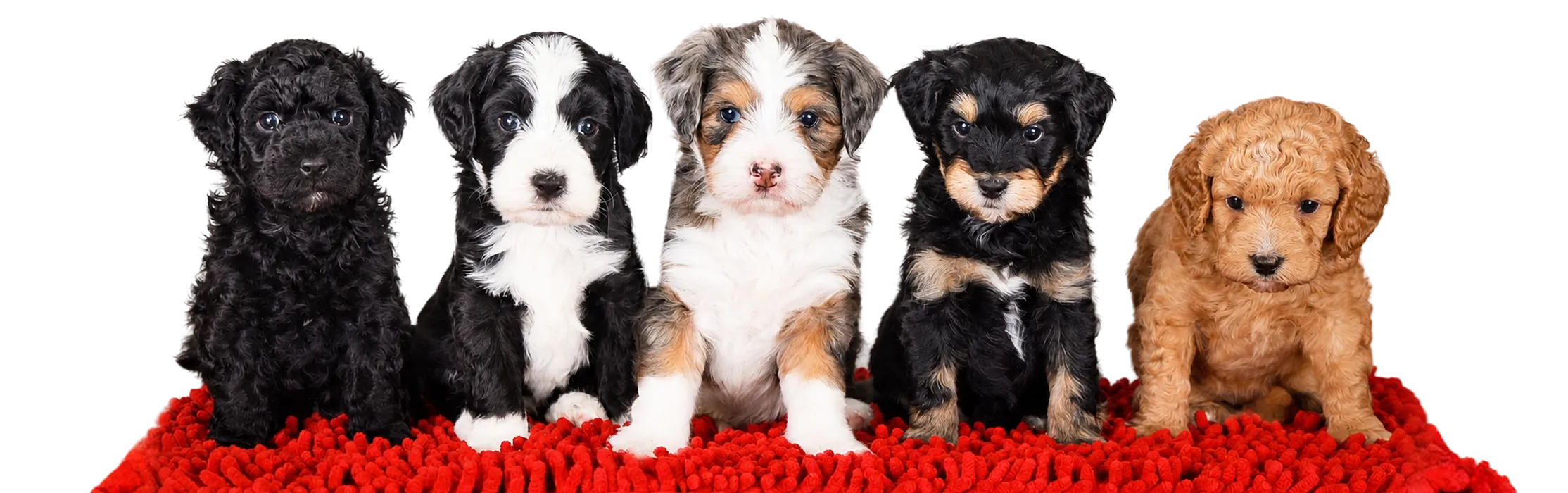
Carrier Family Doodles FAQs
Here are some frequently asked questions we get from adopting families and those considering a new Mountain Doodle puppy. Have a look, and if you still have additional questions or concerns, please send us a text or give us a call.
General Questions About Mountain Doodles
Questions About Carrier Family Doodles
Questions About Puppy Care
Other Questions
What about Puppy Potty Training?
Because Carrier Family Doodles' puppies are home-raised, we are just as concerned about puppy potty training as you are! This is a detailed topic, so we devoted a whole page to the subject of potty training.
Will The Puppy Have Vaccinations And Deworming Before Coming Home?
Yes. At Carrier Family Doodles, the health of our Golden Mountain Doodle and Aussie Mountain Doodle puppies is a top priority.
Our puppies are typically dewormed 3 times before going home (commonly at 3, 5, and 7 weeks of age) and receive their first puppy vaccinations, including:
- Parvo vaccine around 4 weeks
- 5-way puppy vaccine around 6 weeks
Each puppy also receives preventative parasite treatment before going home to help protect against common puppy parasites such as giardia. While our puppies are routinely monitored and tested, preventative treatment helps ensure the healthiest possible start for your puppy.
If a puppy leaves before we are able to complete a scheduled treatment, we may send the medication home with instructions for administration.
All puppies receive a final veterinary health check around 7 weeks of age before going to their forever homes. A detailed health record is included so your veterinarian can continue vaccinations and care on schedule.
Most puppies will need an additional booster vaccine at approximately 10-12 weeks of age. If your puppy remains with us beyond that age, we can usually administer the booster, sometimes for a small additional fee.
Learn more about our puppy health program and health guarantee on our Health Guarantee page.
Can I Take My Puppy To Public Places When I First Get Them?
There is an important period of time between 8-16 weeks when puppies learn many of their social skills, but it is also a time when fears and nervous behaviors can develop. We want our puppies to be kept safe from communicable diseases before they are fully immunized (which is typically under 16-18 weeks), but it is also important to have them meet new people, dogs, smells, sounds, and textures during this time.
Having your puppy go with you to safe places - trusted family members and friends' homes where you know that their dogs are healthy and fully immunized is a good compromise between keeping your puppy away from potential illnesses but also allowing them to experience new things to help them develop into confident, well-adjusted adults.
Taking them for car rides and having positive experiences is SO important, but also keep them away from places that carry high risks for Parvo and other illnesses. Keep your under-immunized puppy away from pet stores and high-traffic places like dog parks and sidewalks. When you go to the vet, hold your puppy off the ground or keep them in a crate.
Puppies lick their paws, and so be aware in the first 2 months that they can pick things up at places like the vet from other sick dogs, but taking precautions like removing your shoes before entering your house and not letting the puppy lick shoes and other contaminated surfaces will help reduce the risk. Don't let your puppy miss out on fun new experiences, but just be careful about how you do it.
What should I feed my puppy?
At Carrier Family Doodles, our Golden Mountain Doodle and Aussie Mountain Doodle puppies are typically started on Black Gold Explorer while nursing and transitioned to Purina Puppy Chow Beef & Rice by weaning age.
We chose Purina Puppy Chow because it is a quality puppy food that is a great value for quality and widely available for families throughout the United States. Every puppy goes home with a quart-sized starter bag of their current food to help make the transition easier.
We occasionally introduce foods other than the Purina Puppy Chow, and will try to let you know if that is the case when you bring your puppy home.
If you prefer a different puppy food brand, we recommend gradually mixing the new food with the starter food over several days to help avoid digestive upset. We also send home some powdered puppy probiotic, which is great for keeping intestinal balance during food transitions, as well as pumpkin powder, which can be used as a nutritive source of fiber to firm up loose stools that may result from feeding changes.
Our puppies are raised on free-choice feeding and eat as needed throughout the day. Once home, most puppies do well being fed 3 meals per day, typically around 3/4 cup per feeding, depending on age, size, and appetite. Adjust portions as needed based on your puppy's activity level and hunger.
How Often Should I Feed My Puppy?
Most puppies will need to eat 3 times a day (breakfast, lunch and dinner). The quantity varies, depending on the age and size of the puppy, and the quality of the food. If you aren't feeding a certain amount daily, we recommend giving them a generous bowl of food for 10-15 minutes, and once they lose interest in eating, take it away. A mini puppy will generally not eat more than 1/2 to 1 cup of food at each feeding, but allow for individual differences. Take your puppy out to the bathroom within 20-30 minutes of eating.
Since dogs can eat a lot at one feeding and then not have appetite at the next, allow your puppy some flexibility without worry. Do be sure your puppy has ongoing access to clean drinking water and is staying hydrated.
Days 1-3 after go-home are a settling-in period where your puppy is becoming familiar with a new place and new people. Extroverted puppies will often thrive on this transition, but a quieter puppy may need these first few days to adjust and feel comfortable. It is not uncommon for puppies to eat very little (sometimes not at all) during these first days. This is normal and not a cause for alarm. As long as your puppy drinks water and urinates, and otherwise seems happy with tail wagging frequently, expect that their appetite will increase along with their comfort level.
Don't feed your puppy too late at night or your pup will need to go to the bathroom more often when you want to be sleeping!
What if I can't pick up my puppy right away?
The prime socialization window for puppies is 3-16 weeks. This doesn't mean a puppy's temperament or responses are fixed and unchangeable after 16 weeks, but the go-home, settling-in period demands a little more patience at and after 16 weeks. With few exceptions, our puppies are placed in their forever homes between weeks 8-12.
As already mentioned, we offer a 5-7 day grace period for pick up after adoption day. If you have travel plans or other extenuating circumstances that make it more practical for you to bring your puppy home a little later, we can arrange for longer-term boarding if needed. We prefer to board for three weeks or less. Our current rate is $50/week, subject to additional and agreed-upon charges for vaccinations to keep puppy on-schedule or other special services.
When Can My Puppy Come Home?
Puppies can go home at 8 weeks old. You should make arrangements in advance for your go-home day. Since adoption days often fall during the week or there may be conflicts with schedules, we typically offer a 5-7 day grace period for puppy pick up.
As important as the first 8 weeks are in a puppy's development, most of a puppy's training and socialization happens after they leave us...when they go home with you! Our ideal is to have puppy go home as close to 8 weeks as possible.
How to Avoid Getting Scammed When Adopting a Puppy
We talk with a lot of people who either got scammed or almost got scammed and are very nervous because they don't know how to avoid it happening again. Here are a few tips on how to steer clear of shady websites and scammers who are only out to get your money. We have done a bunch of research on scam websites and can now spot one easily without ever talking to the people who are running it.
Click here to read an informational article with some tips for recognizing and avoiding scams.
If someone should contact you claiming to be affiliated with Carrier Family Doodles and you're not sure, feel free to call or text me (Cindy) at 765-318-1123. We always use an email address associated with our business website, ending in @carrierfamilydoodles.com.
How Does the Carrier Family Doodles Puppy Giveaway Work?
Why We Offer a Giveaway Puppy
We know that some families deeply desire a Golden Mountain Doodle for companionship, emotional support, or as a special blessing during a difficult season of life, yet may not be financially able to afford one.
As Christians, we believe in giving back from what God has blessed us with. Because of this, we occasionally offer giveaway puppies to families with special circumstances or meaningful needs. Additional details, terms, and application information can be found on our Giveaway Puppy page.
Please note that applications may not be kept in queue beyond the time period of the current puppy giveaway. This is not a raffle or lottery randomly selected, but is discussed among our family members with a mutual decision being made on the basis of details in individual applications. We do not guarantee a puppy to any applicant, but do offer our consideration in the giveaway process.
While we would like to offer every qualified applicant a puppy, obviously this is not possible. Additionally, our preference is to let each applicant know if they have not been selected to receive a giveaway puppy. However, the volume of applications we receive usually limits our ability to respond individually. If we do not contact you with an offer to welcome a giveaway puppy into your home, please understand that we have considered your application and selected another applicant.
What Makes Carrier Family Doodles Different?
At Carrier Family Doodles, our puppies are raised in our home as part of our family - not in a kennel environment. We focus on smaller-sized Mountain Doodles with excellent temperaments, low-shedding coats, early socialization, health-tested parent dogs, and early potty training. We also provide ongoing lifetime support for our puppy families long after adoption day.
Is My Deposit Refundable?
The $100 fee to join our waitlist is generally non-refundable. The only exceptions to this are made on a case-by-case basis, and generally only if we would not have a good match for your preferences with our upcoming parent combinations.
Once you pay the $500 deposit for a named puppy (whether chosen during early selection or public availability), that fee is also generally considered non-refundable. However, we know that there are often extenuating circumstances and financial considerations for families.
We are very open to considering either a full or partial refund of the deposit in the case of hardship. However, the amount of refund will be decided on a case-by-case basis depending on the puppy age, how many puppies remain in the litter, whether the puppy had other serious interest, and other factors.
Do You Provide a Health Guarantee and Warranty?
At Carrier Family Doodles, we are committed to raising healthy, well-socialized Golden Mountain Doodle and Aussie Mountain Doodle puppies through responsible breeding, health-tested parent dogs, and personal in-home care.
We offer a 60-day health warranty. You are responsible for bringing your puppy to your vet within 72 hours of pick up, to confirm the puppy's health going from our home to yours. If anything comes up outside of the range of normal, we do not reimburse the cost of the initial vet visit, but we will reimburse for the cost of any testing and treatment until the initial issue is resolved (up to 60 days). Our puppies typically pass their go-home vet check with flying colors. An occasional positive giardia test or mild ear infection may be the exception to this rule, and this is what our health warranty is designed to cover. We do not cover any health issues that surface after this go-home exam.
We offer a 2-Year Genetic Health Guarantee on our puppies. While no breeder can guarantee perfect lifelong health, we carefully select and health test our breeding dogs to help give every puppy the best possible start in life. We will reimburse the cost of any testing or treatment for issues that are genetic in nature and are tested on our parent dogs' standard panels, up to the amount of the price paid for your puppy.
Of course, since our adult dogs are health tested, there should not be genetic issues with our puppies, so the genetic guarantee is largely for your confidence.
Our health guarantee specifically excludes treatment for hip dysplasia. While this can arise from a genetic pre-disposition, it can also be caused by environmental factors, such as over-doing exercise sessions, high-impact play, rapid growth due to over-feeding, excess weight, and accidents or injuries (often due to play on slippery surfaces), and early spay/neuter and its effects on bone density.
Our commitment to our puppy families continues long after adoption day. We provide ongoing lifetime support and are always available to help with questions or concerns as your puppy grows.
Learn more about our breeding standards and puppy health guarantee on our Health Guarantee page.
Do You Remove Dew Claws?
We do not remove dew claws on our puppies. Some are born without them. For those that do have them, we believe dew claws are a natural part of a dog's anatomy and, in most cases, puppies can live comfortably and happily without removal. While some breeders choose to remove them, we prefer to leave them intact and allow families to make any future decisions together with their veterinarian if needed.
The only time we may opt for removal is if the dew claw is not firmly attached to bone and poses a risk of snagging and being pulled out.
I Live Out of State, How Can I Pick Up My Puppy?
Local pickup and ground shipping
Local pickup is welcome and encouraged, but we do have a large number of people that opt for the convenience of our ground delivery. We can (in most situations) deliver directly to your home or a proximate public meet-up location. Our current delivery rate is $125 to any location within four hours of us in New Concord, KY. Rates are subject to change, depending on current gas prices, so it is recommended that you confirm our current pricing if you want to take advantage of the delivery option.
We do travel distances greater than four hours, but the rate is variable. Contact us for a quote.
If we have more than one puppy going to the same area, we can often split the delivery fee and get a much better rate. We would be happy to discuss the options with you and help you decide which option is best for you.
Flying Puppies
We do not hire outside flight nannies. Our puppies are personally delivered by one of our Carrier Family Doodles team members. The puppies are flown with us in the cabin and are delivered to you at your local airport. They are carried in a breathable, soft travel carrier, have a chance to go to the bathroom along the way, and get lots of love and snuggles as they travel. Our flight nanny fee is $350. You will be responsible for purchasing the flight, which includes a $125 pet fee. If the flight fee is not paid in advance, but we are expected to pay it when boarding, that charge will be added to your final balance. You will be expected to meet us at our arrival gate at your local airport.
Airport Pickup
If you want to fly the puppy yourself, we can meet you at the Nashville International Airport for $125 within business hours. You will be responsible for purchasing your own airline tickets, with your flight arriving during normal daytime hours.
How do I make my final payment?
Final puppy balances, including any delivery or transportation fees, are due at pickup or delivery unless alternate arrangements have been made in advance.
We prefer final payments via cash, Zelle, or Venmo. Final balance payments made through PayPal or Credit Card are subject to a 3% processing fee. (We cover the processing fee on all initial reservation deposits made by PayPal or Credit Card.)
Puppy payments can be made online; however, please confirm final amount before submitting this payment.
Do The Puppies Come With Spay And Neuter Contracts?
While we do not have a binding contract, we do strongly recommend our puppies to be spayed/neutered. Since our Mountain Doodles are already a triple-cross, designer Doodle, any potential breeding would need to be carefully thought-out.
Do You Offer Breeding Rights?
Because our Mountain Doodles are already a multi-generational hybrid breed focused primarily on family companionship, breeding rights are generally not offered. However, in rare situations we may consider them for approved programs that closely align with our breeding goals and values.
Can I Visit the Puppies Before Reserving?
Yes, in many situations we can arrange visits by appointment. However, because we are a family-based program and prioritize the health and safety of our puppies, visits may sometimes be limited depending on puppy age, vaccination status, scheduling, and litter circumstances. We are also happy to provide photos, videos, and video calls for out-of-state families to assist in the selection process.
Why Are Your Puppies More Expensive Than Some Other Breeders?
Responsible breeding involves significant time, expense, and personal investment. At Carrier Family Doodles, our pricing reflects health testing, quality nutrition, home raising, early socialization, early potty training, veterinary care, carefully selected bloodlines, and the lifetime support we provide our families. Our goal is not simply to produce puppies, but to raise healthy, well-adjusted companions with exceptional temperaments.
How Much Do Our Puppies Cost?
At Carrier Family Doodles, our puppies are home-raised, well-socialized, and bred with a focus on health, temperament, and lifelong family companionship. We specialize in hypoallergenic, no-to low-shedding Doodle breeds raised in a loving family environment - not kennels.
All of our parent dogs are health tested, and our puppies receive daily personal interaction, ENS and early socialization, intentional sound familiarization, and early potty training using our indoor astro-turf system. Many families report their puppies go home already 90-95% potty trained.
We believe pricing should reflect the quality of care, health testing, socialization, customer support, and the overall experience you receive - not just the puppy itself. Our puppies typically range from $1,650-$2,450, depending on breed (Golden Mountain Doodle versus Aussie Mountain Doodle), color, markings, and furnishings.
Every puppy also goes home with a starter gift bag including food, toys, collar, leash, brush, and more. Most importantly, we provide ongoing lifetime support for our puppy families long after adoption day.
We are committed to raising healthy, confident puppies with exceptional temperaments and giving them the best possible start in life.
Please note, our puppies are individually priced on our website. The only additional charges are: 1) sales tax of 6% if you reside in KY, and 2) a mutually-agreed-upon delivery charge if you decide to take advantage of this option.
Where is Carrier Family Doodles Located, and How can I get my Puppy Home?
Carrier Family Doodles is located in New Concord, Kentucky, conveniently positioned for families throughout the Midwest and Southeast. We are approximately:
- 2 hours northwest of Nashville, Tennessee
- 3 hours northeast of Memphis, Tennessee
- 4 hours southeast of St. Louis, Missouri
- 4.5 hours north of Birmingham, Alabama
- 5 hours south of Indianapolis, Indiana
- 5 hours south of Cincinnati, Ohio
- 6 hours west of Atlanta, Georgia
- 7 hours south of Chicago, Illinois
We are also located about 2 hours from Nashville International Airport, making air travel and fly-in pickups convenient for out-of-state families.
While based in Kentucky, we regularly work with families across the continental United States and frequently hand-deliver Golden Mountain Doodle and Aussie Mountain Doodle puppies to major cities throughout the U.S.
For more information about puppy pickup, transportation, and delivery options, please visit our Purchase Policies page.
What Happens After I Reserve My Mountain Doodle Puppy?
After you successfully reserve your new family member, the next steps focus on getting you ready to bring your Mountain Doodle puppy home.
1. Bringing Your Puppy Home
You have several options for receiving your puppy: local pickup, ground delivery to your home or a meeting point, a flight nanny who personally escorts your puppy in-cabin, or airport pickup where you fly to meet us.
As a reminder, final payment is due at pickup or delivery, and we'll send an invoice detailing the balance beforehand.
2. Thinking About Your Puppy's Health And Diet
In your Puppy Welcome Bag, you'll receive a small starter supply of our current puppy food. This is usually Purina Puppy Chow beef & rice, but we occasionally test other options, so this is subject to change. If we don't let you know, please ask. You can stick with what they are currently eating, or use the starter bag to mix with a new food to transition to something you prefer.
We ask that you schedule a vet visit within 72 hours of bringing your puppy home; remember to take their health records with you. This is to ensure the health of your puppy as they transition from our home to yours, and this activates your 60-day warranty and 2-year genetic guarantee.
3. Preparing for Training Your Puppy
Consider your puppy's training needs. We highly recommend Baxter & Bella online puppy school for comprehensive virtual support. If you purchase the Baxter & Bella course through us, you will receive a significant discount, and you can begin even before your puppy goes home!
What is the Current Wait Time for a Mountain Doodle Puppy?
We generally expect 12-15 litters of mini Golden Mountain Doodles and 2-4 litters of mini Aussie Mountain Doodles per year. Of course, this is a natural process, so there are no guarantees, but we can always let you know our best guesses if you are looking for puppies with a certain look or at a certain time.
Our approximate "wait time" typically ranges from 2-6 months, more or less depending on your personal preferences regarding color, gender, etc.
We only breed our females if they are healthy and ready for pregnancy. Even then, there is no guarantee that they will have puppies, or how many they will have if they do get pregnant. While we can give you a good idea of what to expect and when, there of course must be allowances for variables in the natural processes.
How Does the Puppy Selection Process Work?
We have a wait list for those who know they want a Carrier Family Doodles puppy. Our wait list is ordered by date of sign up, and early selection opportunities are given in that order. We often have multiple litters born within days or weeks of each other, so you can often select across litters.
Generally, you would indicate your preferences on your wait list form, and we would only contact you for selection if there is a potential match. However, you are free to select from any litter at any time. If timing or potential matches are not your ideal, you can stay on the wait list until the options align and you wish to move forward with a reservation.
Currently, if you sign up for our wait list, the fee is $100 (as a sign of commitment). This comes off your final balance, so it is not an additional charge. Joining our wait list also gives you an additional $100 discount when you reserve your puppy.
After early selections take place, all puppies remaining available become open for public reservation.
See our Wait List Details page for more details.
Why do Puppies Have Pink Noses?
All Mountain Doodles are born with pink noses. As the puppies grow older, their black pigmentation sets in and the nose fully fills to a nice black. Most puppies have a fully black nose by the time they are 8 weeks old. Some puppies will take longer and may not have a fully black nose until they're 2-4 months of age. The occasional puppy will retain a pink spot here or there on the nose, but for the most part they become uniformly black (or, in some cases, brown).
What Colors Do Mountain Doodles Come In?
Mountain Doodles can come in a wide variety of beautiful colors and patterns depending on the parent breeds and genetics involved. Common colors include black or black & white, cream, red or apricot, golden, Merle, phantom, parti, and classic tri-color markings. Every litter is unique, which is part of what makes Mountain Doodles so special.
What's the difference between Furnished and Unfurnished?
Furnished Doodles are best known for their signature "teddy bear" appearance, including eyebrows, beards, fluffy facial furnishings, top-knots, and fur around the paws. Furnished Doodles are typically low-shedding and considered hypoallergenic, making them a popular choice for families with allergies.
Unfurnished Doodles - sometimes called flat-coated or improper-coated Doodles - usually have shorter facial hair, flatter muzzles, and a more traditional look similar to the Golden Retriever, Australian Shepherd, or Bernese Mountain Dog parent breeds. While unfurnished Doodles often shed much less than the parent breeds, they are generally not considered fully non-shedding or hypoallergenic. Many families love the flatter coat look and appreciate the lower grooming requirements.
Furnishings are determined completely by genetics and do not change with age. Coat texture and furnishings are separate traits, meaning a puppy can be straight-coated and furnished or curly-coated and unfurnished. Puppy coats also change as adult coats come in, often becoming wavier or curlier over time.
At Carrier Family Doodles, we help families choose the right puppy based on allergies, grooming preferences, coat type, and lifestyle. If allergies are a concern, we strongly recommend spending time around furnished Doodles before making a decision.
What is the Difference Between an F1 and F1B?
F1 means a first-generation cross between a purebred parent and a Poodle, such as a Bernese Mountain Dog, Golden Retriever, or Australian Shepherd crossed with a Poodle. F1B means an F1 Doodle bred back to a Poodle (giving the puppy a higher percentage of Poodle genetics).
At Carrier Family Doodles, our parent dogs are primarily F1 and F1B Bernedoodles, Goldendoodles, and Aussiedoodles. Because of this, our Mountain Doodle puppies are typically an F2 or F2b generation, which some may simply call "multi-generational." Some of our parent combos have a higher percentage of Poodle genetics, helping produce more consistent low-shedding, allergy-friendly coats while still preserving the color, temperament, and other desirable traits we love in the parent breeds.
What Are the Grooming Requirements For Mountain Doodles?
Mountain Doodles are like Poodles in that they are single-coated, with hair, not fur. This means that they will require regular brushing to keep them free from matting. We generally recommend brushing 1-2 times per week for straight- and wavy-coated Mountain Doodles, and 2-3 times per week for curlier coats. Curly coats usually require a professional groom every 6-8 weeks, whereas wavier coats can usually stretch to 8-10 weeks. From the time they are puppies, it is a good idea to brush your dog's hair frequently to get them used to regular grooming. A high-quality wire slicker is the best option for brushing.
The frequency of grooming and style of grooming (more or less "floof") depend on your preferences and your dog's activities. An active outdoor doodle will enjoy a shorter cut more frequently. Beginning the grooming process as soon as you bring your puppy home will go a long way in ensuring that grooming becomes a wonderful bonding experience between you and your pet!
The curlier the coat, the more professional grooming they will need. Without grooming, the dog runs the risk of getting a matted coat and may need to be shaved to prevent further issues. A wavy or straight coat can be easily groomed by brushing when you bathe your dog (bi-weekly, monthly, etc). Regardless of coat type, a commercial de-tangler may help your puppy with the process and make it more manageable for you.
What Are the Sizes of Mountain Doodles?
Carrier Family Doodles has come to specialize in the "mini" Mountain Doodle, although changing definitions may affect what people consider "mini." As such, we will generally provide a weight range for what you can expect for our puppies as they grow into adulthood. This derives from the parents' weights (and their Embark-identified "genetic weight"), as well as known adult sizes of previous puppies from our various parent combinations.
Our Mini Mountain Doodles are intentionally bred from smaller bloodlines, with parent dogs typically ranging from about 15-30 pounds. Most of our puppies mature between approximately 15-40 pounds (depending on the parent combo), with females usually being somewhat smaller than males.
Can Mountain Doodles Be Left Alone During the Day?
Mountain Doodles are very social dogs and thrive on companionship and interaction with their families. However, most can adapt well to normal family work schedules when given proper exercise, attention, and routine. Young puppies will naturally require more frequent potty breaks and supervision.
If you expect to leave your puppy alone for longer periods of time (i.e., during a normal work day), we generally would not recommend crating for more than a couple hours. You could opt for a puppy "play yard" in a safe location (kitchen, laundry room, or living room, with a waterproof underpad if needed). Our puppies are well-trained to an Astroturf potty system, and many new owners have kept with this in a play yard to help make longer puppy alone times more manageable. An intentionally-designed play yard can include a crate, food and water, Astroturf, and regularly rotated toys to keep puppy's attention.
Are Mountain Doodles Easy to Train?
Yes. Mountain Doodles are typically intelligent, eager to please, and highly trainable. Because of their strong Poodle influence and family-oriented temperament, most families find them responsive to positive reinforcement and consistent training. Early socialization and routine training are always encouraged.
How Much Exercise Do Mountain Doodles Need?
Mountain Doodles enjoy regular playtime, walks, and interaction with their families, but our mini lines are generally easier to manage than larger, high-energy working breeds. Most do very well with moderate daily exercise and enjoy both indoor family life and outdoor activities.
It is generally recommended to limit puppies to shorter, more frequent play sessions, and to be cautious of high-impact activities to protect growth plates before the adult size and conformity are reached.
Do Mountain Doodles Bark a Lot?
Most Mountain Doodles are not excessive barkers. They may alert you when someone arrives or when something unusual catches their attention, but they are generally known for being friendly and people-oriented rather than highly territorial or aggressive. Proper training, socialization, and exercise also play an important role in behavior.
Some of our Mountain Doodles will bark more than others, but it is usually a really cute vocalization to accompany play, to show excitement, or to invite engagement, rather than a breed characteristic.
Are Mountain Doodles Good With Children?
Yes. Mountain Doodles are typically wonderful family dogs and are known for being affectionate, social, playful, and people-oriented. Our puppies are raised in a busy family environment around children and regular household activity, helping them develop into well-socialized companions. As with any dog, children should always be taught how to interact gently and respectfully with puppies.
What Is the Life Expectancy of a Golden Mountain Doodle or Aussie Mountain Doodle?
The Golden Mountain Doodle was first developed around 2013, and the Aussie Mountain Doodle followed several years later. Because these are newer, designer breeds, long-term lifespan data is still limited. However, the life expectancy of their parent and related breeds gives a good general estimate.
Typical lifespan ranges include:
- Mini Goldendoodles: approximately 12-16 years
- Mini Aussiedoodles: approximately 12-15 years
Based on these averages, Golden Mountain Doodles and Aussie Mountain Doodles are generally expected to fall within similar lifespan ranges, depending on genetics, size, diet, exercise, and overall care.
At Carrier Family Doodles, all parent dogs are health tested prior to breeding to help produce healthy, long-lived puppies with excellent temperaments. We proudly back our puppies with a 2-Year Genetic Health Guarantee for added peace of mind.
To learn more about our health testing and puppy health guarantee, please visit our Health Guarantee page.
What Are the Main Differences Between an Aussie Mountain Doodle and a Golden Mountain Doodle?
While both breeds share many wonderful Mountain Doodle qualities, they do have some slight temperament differences. Both breeds are intelligent, loving, family-friendly, and highly people-oriented. Golden Mountain Doodles are typically a little calmer and more relaxed, often excelling as affectionate family companions and emotional support or therapy-oriented dogs. Aussie Mountain Doodles, with a working-dog background, can be more active and alert, and do best when they have "purpose." We like to say they make a loyal companion with a farm dog soul. They are excellent family dogs and adventure companions.
What are the Main Mountain Doodle Coat Types?
Mountain Doodles can have several different coat types, depending on genetics. Mountain Doodle hair styles are influenced by what percentage of Poodle they are, as the other parent's heritage are less curly varieties. The coats primarily fall into three categories.
The Three Different Mountain Doodle Coat Types:
Curly Coat: This coat type sheds the least and is considered the most hypoallergenic. It can feature tight or loose curls with a soft texture, although usually not as tight as a poodle. If they shed, the hair tends to get trapped within the curls, requiring brushing and frequent trimming to prevent matting. This is often the best choice for owners with dog dander allergies.
Wavy Coat: The free-flowing, wavy coat is typically no-to-low shedding. You may see occasional "flyaway" with rough petting or if grooming and brushing routines are not kept up with. However, you will not typically see active "shedding" on clothes or furniture. Most individuals with dog dander allergies tolerate this coat type well.
Straight Coat: The least common, straight-haired Mountain Doodles are the most likely to put off fur into the environment, although they are usually still considered no-to-low shedding. Despite the name, straight coats can have a slight wave.
Unfurnished: Because our Mountain Doodles are an F2 generation cross (both parents being F1 or F1b Goldendoodles, Aussiedoodles, or Bernedoodles), some parent combinations produce a small number of "unfurnished" puppies.
The unfurnished will have a flat muzzle, rather than the typical "bearded" Doodle look, and they should be expected to shed some. Just how much is anyone's guess, unfortunately, but it's usually a lot less than the parent breeds in the lineage. This lower-level of shedding, and the fact that there are no high-intensity grooming requirements (as with furnished Doodles), makes the unfurnished attractive to those who prefer the classic look of the parent breeds.
It is worthy to note that furnishings and coat type are controlled by different genes, so an unfurnished Mountain Doodle can have a curly or wavy coat, but will have a flat muzzle and no "brows." We have noticed that curlier-coated, unfurnished Mountain Doodles typically shed "less" than the straight-coated, although this is not universally true.
For a more in-depth look at Mountain Doodle hair styles, check out our page with photos and more details on each coat type.
Are Mountain Doodles Hypoallergenic and Non-shedding?
Truthfully, there is no such thing as a non-shedding dog. Because of the Poodle in the mix, our furnished Mountain Doodles are single-coated rather than double-coated. With single-coated dogs (Poodles or Doodles), the fur falls off their coat towards the coat/skin and gets trapped in the fur, rather than being shed off into the environment.
Theoretically (although we have not found any official sources to confirm this), a curly coat may trap more of the fur than a straighter, or even wavy, coat. We have had many adult Doodles of different kinds and can't say that we have noticed more or less shedding between the various coat types, although the one or two where we notice "fly-away" with aggressive petting are those with straighter coats.
Regardless of coat type, regular grooming is vital for Doodles, as the fur that gets trapped in the coat can cause matting if not regularly brushed out.
The Poodle in the mix is known to release less dander than other breeds, which is why they are known as "hypoallergenic." Our fully furnished Mountain Doodles are generally considered as hypoallergenic as well.
While our fully furnished Mountain Doodles (whether straight- or wavy-coated) can be considered hypo-allergenic and non-shedding, we do recommend that those with more serious allergy concerns opt for a curlier-coated puppy if possible. We also always recommend those with more serious allergy concerns to find Doodles locally to interact with, or to visit us personally for puppy selection, before going home with one of our puppies.
Even a fully furnished Mountain Doodle that does not typically "shed" may release fur if regular brushing and grooming routines are neglected. Another key time when you may notice some fur is in the transition from puppy to adult coat (usually 6-ish months).